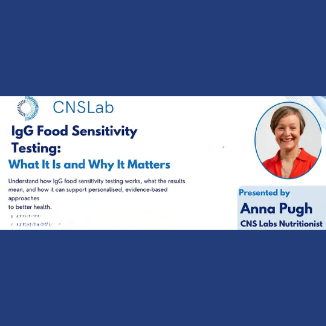
IgG Food Sensitivity Testing: What It Is and Why It Matters
£0.00
IgG food sensitivity testing remains a topic of significant interest—and debate—within clinical practice. This practical webinar will explore the role of IgG food sensitivity testing, clarifying what these tests measure, what they do not measure, and when they may be appropriate as part of a wider clinical assessment.
The session will examine the relationship between food sensitivities, intestinal permeability and chronic inflammatory conditions, while reviewing the evidence supporting IgG-guided dietary interventions. Participants will learn how to confidently interpret an IgG FoodPrint report, identify potential trigger foods, develop practical elimination and reintroduction strategies, and understand the concepts of oral tolerance and immune adaptability.
The webinar will also cover important considerations before testing, contraindications, report interpretation, dietary planning, food rotation, and strategies for supporting gut health. Real-world case studies will demonstrate how results can be applied in clinical practice across a range of patient presentations, including high-reactivity, low-reactivity and vegetarian cases. The session will conclude with a discussion of frequently asked questions and an opportunity for live questions and answers.
Learning Objectives
By the end of this webinar, participants will be able to:
- Distinguish between food sensitivities, food allergies and food intolerances, and understand when IgG testing may be clinically appropriate.
- Interpret IgG food sensitivity test results with confidence and implement practical, evidence-informed dietary strategies.
- Evaluate the evidence surrounding IgG-guided dietary interventions and their potential role in supporting patients with chronic inflammatory conditions.
- Understand the concepts of intestinal permeability, oral tolerance and immune adaptability in relation to food sensitivities.
- Recognise cross-reactivity, allergenic potential and other key considerations that support informed clinical decision-making.
Related products
-

Efficasafe Platform Introduction
Watch Now -

Fibre – From Nutrition Theory to Published Cookbook with Jenny Tschiesche
£10.00 Add to basket -
Chronic Inflammatory Responses: Where Environment and Health Collide
£0.00 Watch Now -

From Clinic to Community: Expanding Your Impact Through Children’s Natural Health Education.
Watch Now